Biscoff Cinnamon Rolls
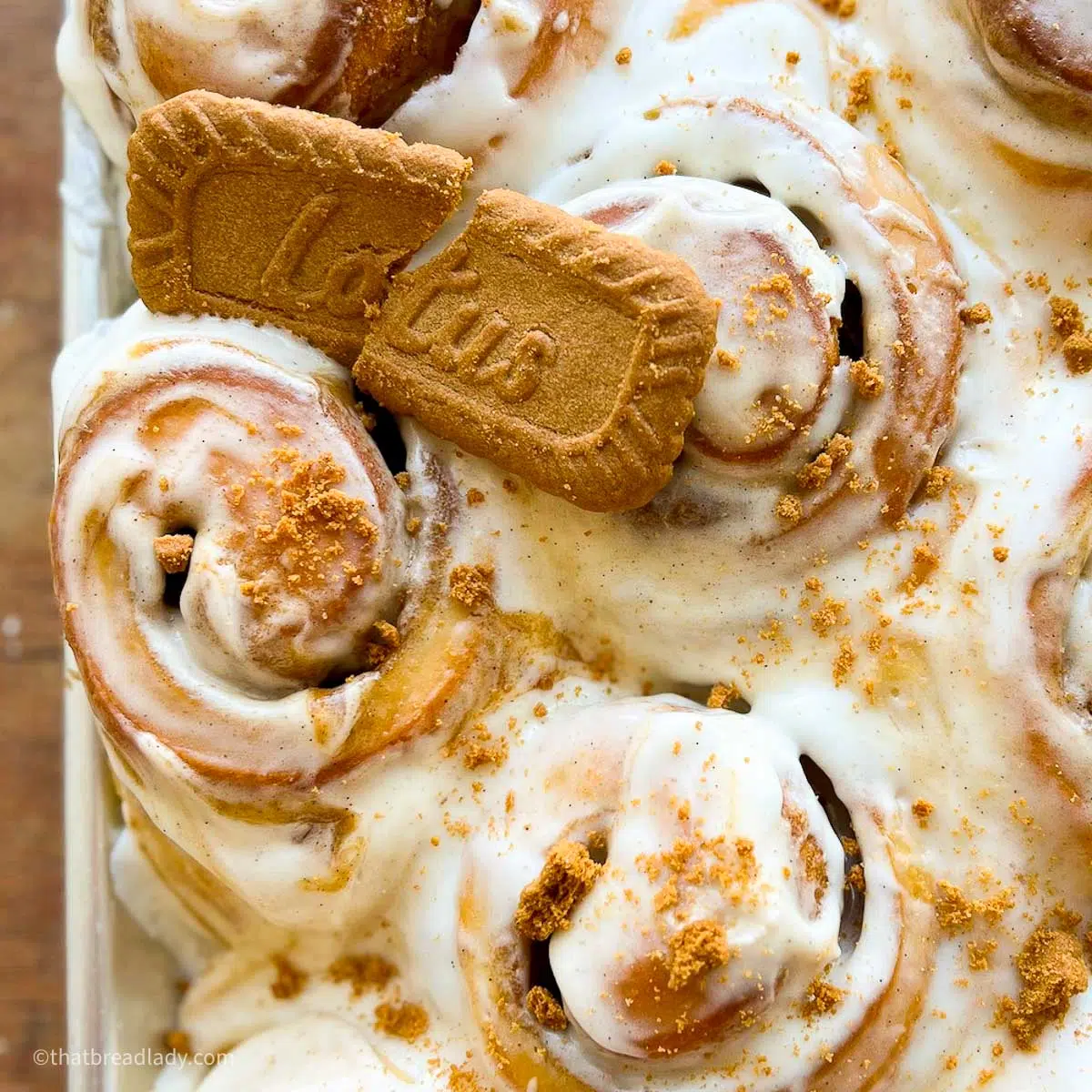
These fluffy cinnamon rolls are filled with a rich Biscoff cookie butter spread, giving a spiced cookie flavor! Top them with brown butter cream cheese frosting while they’re still warm! This flavor combination makes the most decadent cinnamon roll ever! These Biscoff Cinnamon Rolls are going to be your new favorite sweet rolls!
Quick Look: Biscoff Cinnamon Rolls
- Prep Time: 3 hours minutes
- Fermentation Time: 2 hours 15 minutes
- Fermentation Type: Instant yeast
- Bake Time: 22 minutes
- Total Time: 3 hours 22 minutes
- Servings: 18 Biscoff cinnamon rolls
- Calories: 559 kcal
- Cook Method: Baked at 350°F
- Flavor & Texture: Soft, fluffy, gooey cinnamon roll dough with a warm spiced, almost caramel-like flavor from the Biscoff cookie butter and brown butter icing.
- Difficulty: Easy
SUMMARIZE AND SAVE THIS RECIPE CONTENT ON:
As a former bakery owner, I have made literally thousands of cinnamon rolls, plus many different variations like S’mores Rolls and Orange Sweet Rolls. My family loved them, but nothing ever compared to my Homemade Cinnamon Rolls for them.
So when I created this new Biscoff Cinnamon Roll recipe and shared it with my teenage boys, I was shocked by their reaction. They gobbled them up and quickly said, “These are the best cinnamon rolls I’ve ever had!!” I knew then that I had discovered the ultimate cinnamon roll recipe!
Table of contents
- Quick Look: Biscoff Cinnamon Rolls
- Tips for making the Best Biscoff Cinnamon Rolls
- What you’ll love about Biscoff Cinnamon Rolls
- Ingredients
- Substitutions & Variations
- How to Make Biscoff Cinnamon Rolls
- What is the Windowpane Test?
- How to make Biscoff Cinnamon Rolls Ahead of Time
- Frequently Asked Questions
- More recipes to explore
- Biscoff Cinnamon Rolls Recipe
Tips for making the Best Biscoff Cinnamon Rolls
- Don’t add too much flour. This could result in dense, dry cinnamon rolls. If you’re unsure, allow the dough to rest for 10 minutes after kneading, then tap on it with your finger. It should feel soft and slightly tacky, but not wet. If it’s wet, add an additional 1-2 tablespoons flour, mix to combine, then test the dough again.
- Knead the dough until windowpane stage. Gluten is the structure that holds bread together as it rises and bakes. It is developed as the dough is kneaded. A windowpane stage, is when the gluten has been developed enough to create a cohesive dough that can be stretched several inches without easily tearing. Test the dough and knead longer if necessary.
- Add heavy cream before baking. Pouring heavy cream over cinnamon rolls has many benefits. As they bake, the rolls soak up the heavy cream, creating a softer cinnamon roll, and they will stay fresher longer.
What you’ll love about Biscoff Cinnamon Rolls
- Versatile dough recipe: Use this recipe for Crescent Roll Dough too! The recipe can be easily doubled if you have a large capacity mixer.
- Biscoff. Need I say more? Biscoff is a cookie butter spread that has this spicy, cinnamon, cookie flavor.
- Brown Butter Cream Cheese Frosting: Adds a rich, nutty, caramel flavor.
- Make ahead options. Follow my instructions below for ways to prepare cinnamon rolls ahead of time.
Ingredients
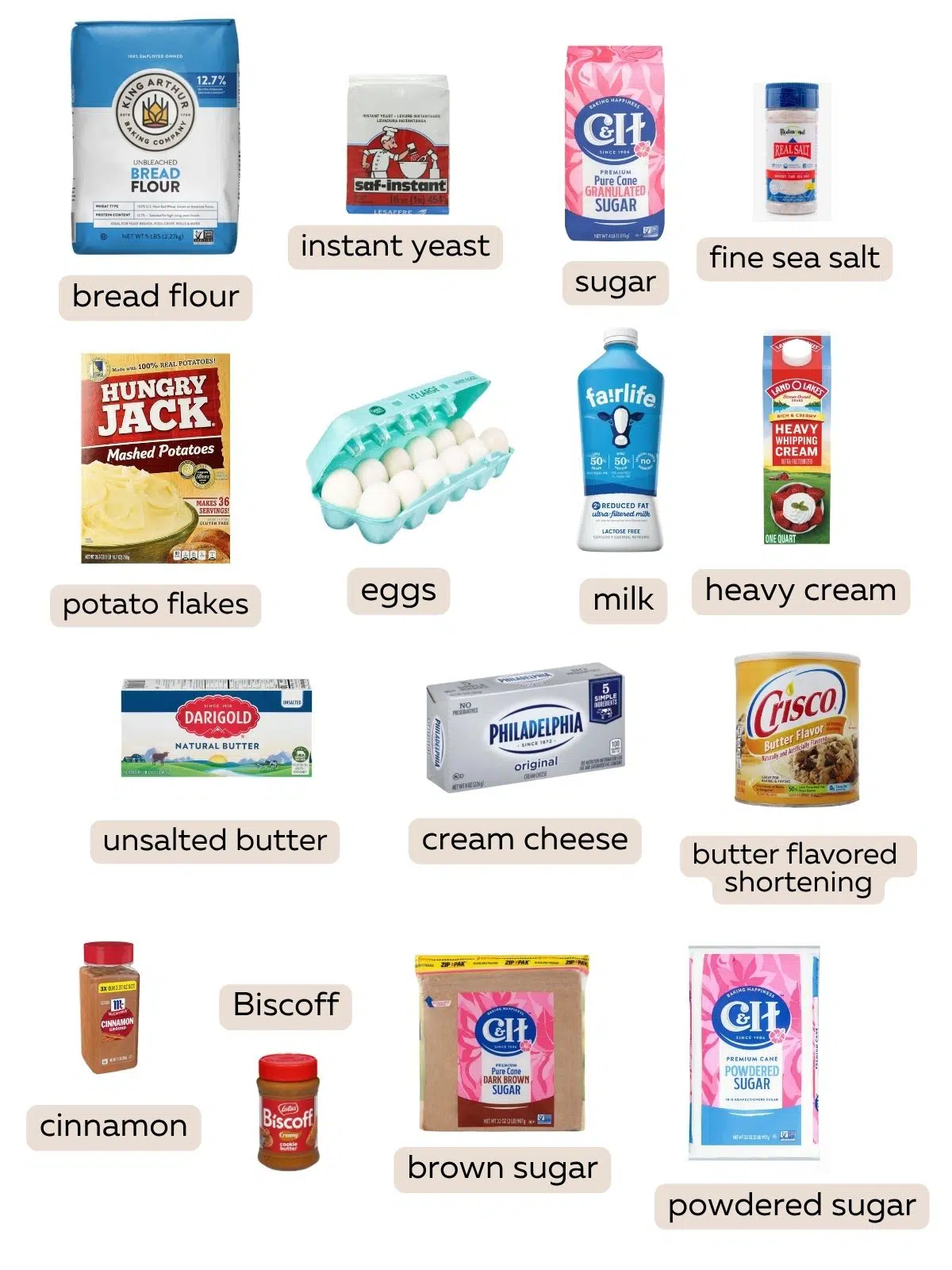
- Biscoff Cookie Butter Spread. Biscoff has a blend of rich and warm flavors like cinnamon, brown sugar, nutmeg and ginger. It gives the cinnamon rolls a warm, cozy flavor.
- Bread flour: Most bread recipes will use bread flour. It has a higher protein content (11-13%) than an all-purpose flour (10-12%). Higher protein flours are perfect for yielding a bread with a strong crumb structure.
- Powdered milk: In baked goods milk provides a creamier flavor and helps yield a more golden brown color when baked. Powdered milk allows you to get the benefits of milk but without adding more liquid to the recipe.
- Instant Yeast: It can be added directly to your recipe without having to proof first. It’s a strong, fast acting yeast that will allow these sweet rolls to rise super fluffy.
- Eggs: Eggs in bread help to create a fluffy, big rise. They are perfect for these rolls, since it’s meant to be soft and fluffy.
- Potato Flakes: Potato flakes make the crumb more moist and tender. The starches in the potato flakes also help the dough to retain its moisture, extending the shelf life of homemade bread.
- Butter Flavor Shortening: The high melting point in shortening helps give a fluffier texture to homemade rolls. And butter flavored shortening adds, you guessed it, more butter flavor!
- Brown Butter Cream Cheese Frosting. Gives these cinnamon rolls an almost caramel-like flavor. It’s a small change that makes a big difference!
*Find a complete list of ingredients and measurements in the recipe card at the end of this post.
Substitutions & Variations
- Powdered milk: If you are looking for a non dairy option, try using a milk powder substitute like coconut, soy or rice powder.
- Instant yeast: You can use active dry yeast instead of instant yeast. You’ll need to bloom (proof) it first by adding it to the water with a sprinkle of the sugar. Let it rest for 15 minutes, making sure it forms small bubbles. If it doesn’t, replace the yeast with. a fresh packet.
- Potato flakes: You can substitute this with plain, boiled and mashed potatoes, cooled to room temperature. You could also swap out the potato flakes with equal parts potato flour.
- Butter Flavored shortening: If you can’t find the Butter Flavor Shortening, use plain shortening – it will still turn out amazing! If you prefer to not use shortening, replace it with equal parts unsalted butter.
How to Make Biscoff Cinnamon Rolls
Make the Brown Butter
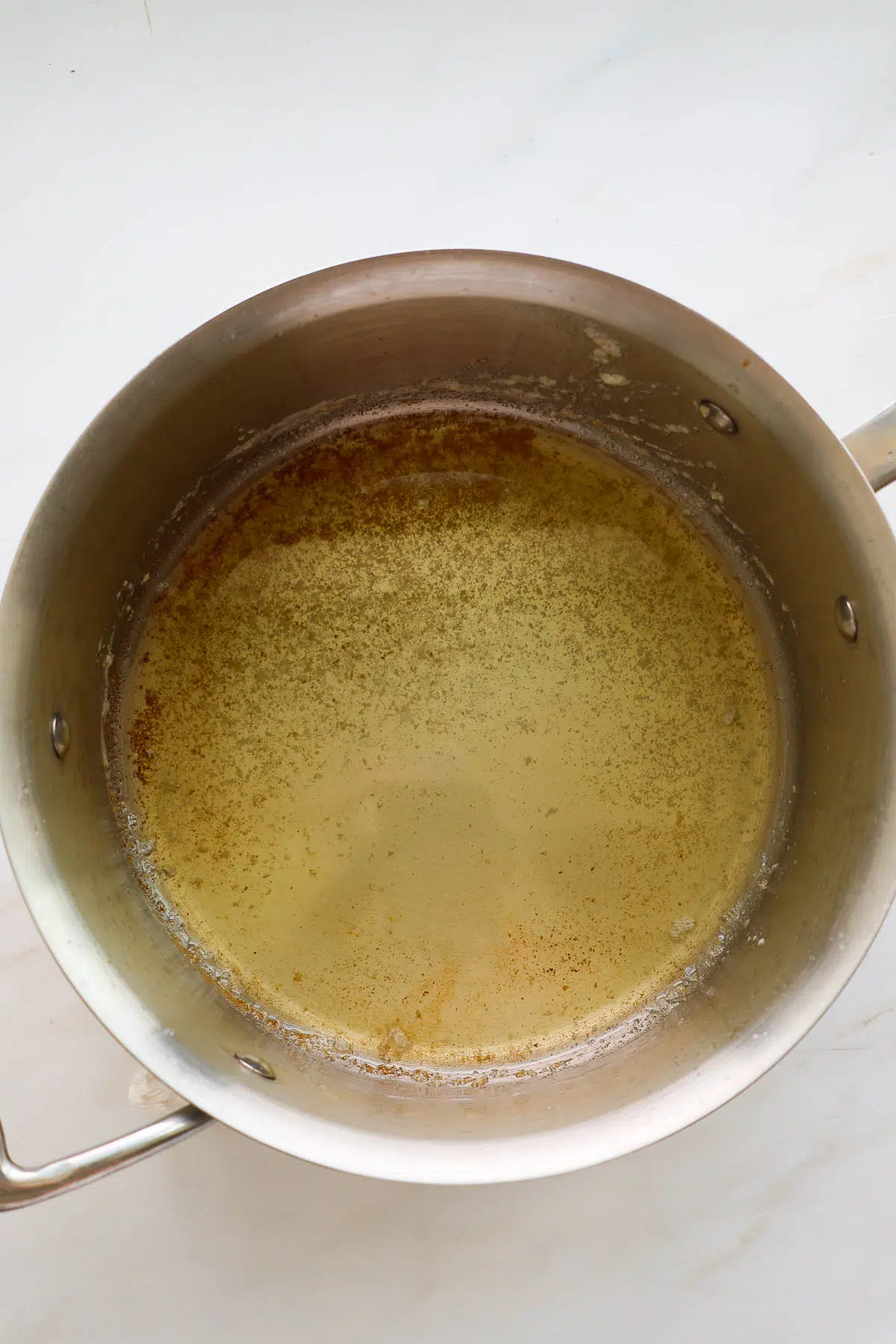
Step 1: Since the brown butter needs about 2 hours to firm up, I suggest making this before the dough. Brown the butter in a light colored saucepan. Melt it on medium low heat and stir constantly until it comes to a light amber color, and you can smell a nutty aroma.
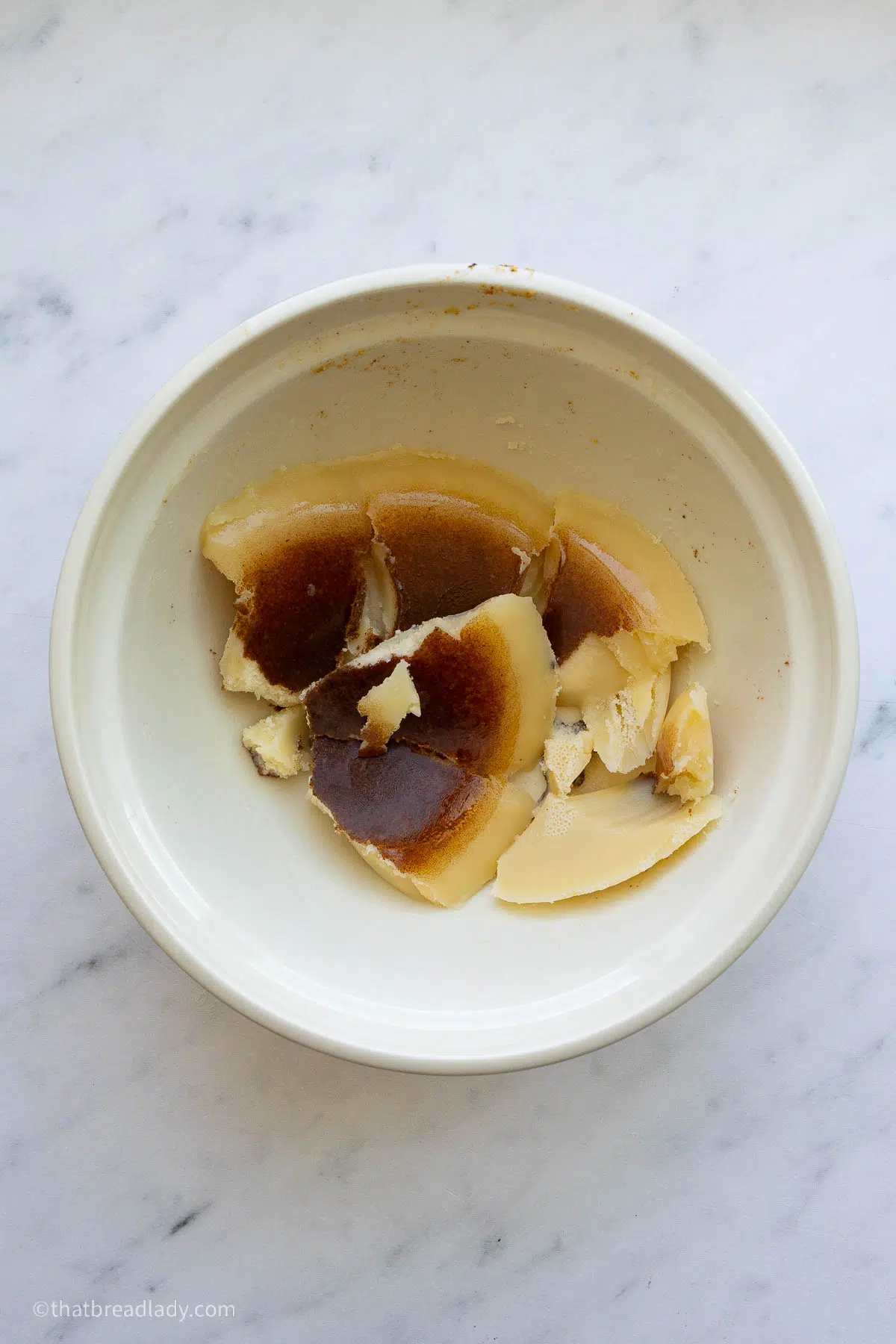
Pour it into a heat safe bowl, making sure you scrape out all those brown flecks of toasted milk solids (that’s where all the flavor is!). Refrigerate for 2 hours, until it comes to a solid. Break it up instil pieces before mixing the frosting. While it’s chilling, make the roll dough.
Mix the dough
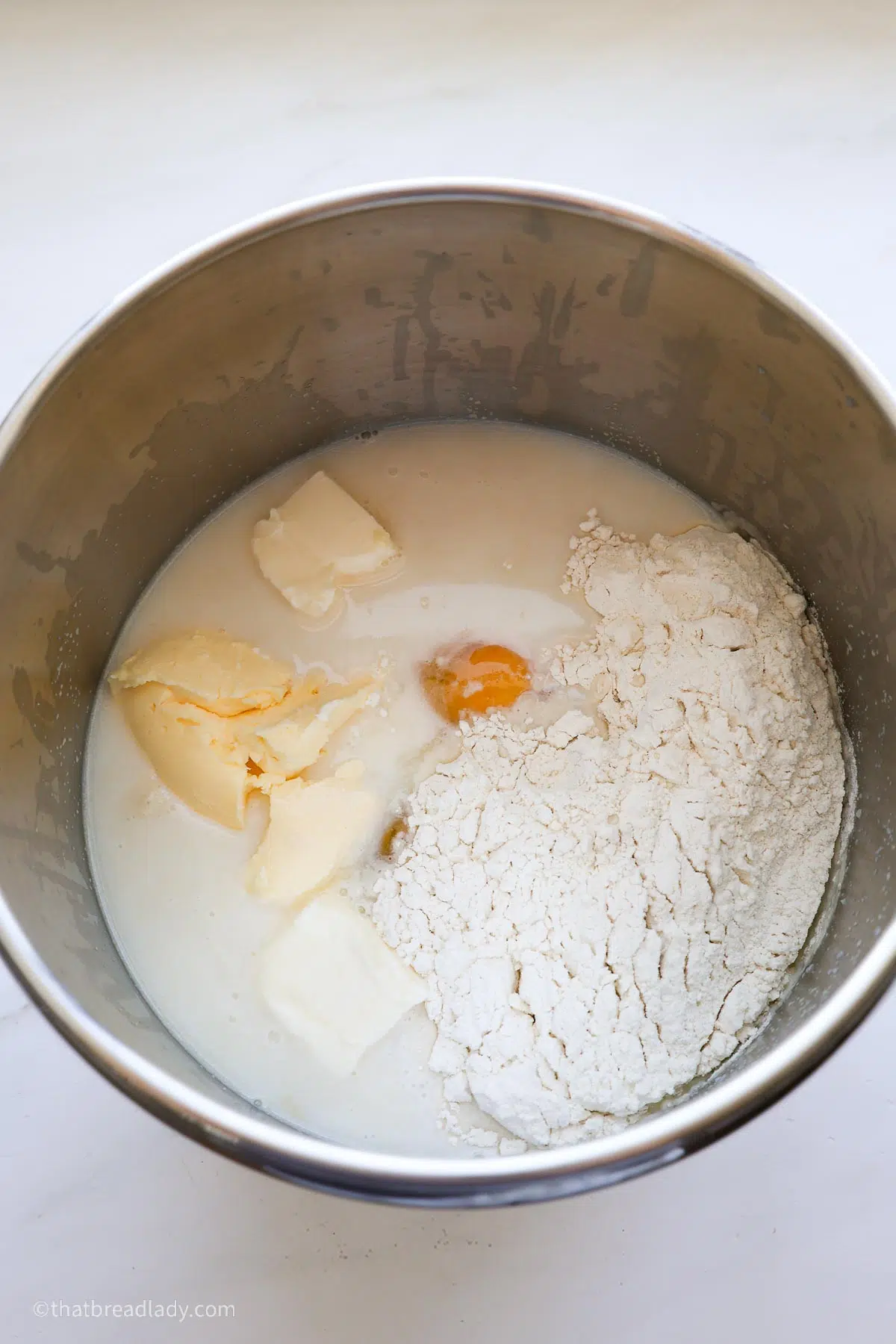
Step 2: Add all the dough ingredients to a mixer bowl, but only half the flour. Attach the dough hook to your stand mixer. Mix until smooth and no lumps remain.
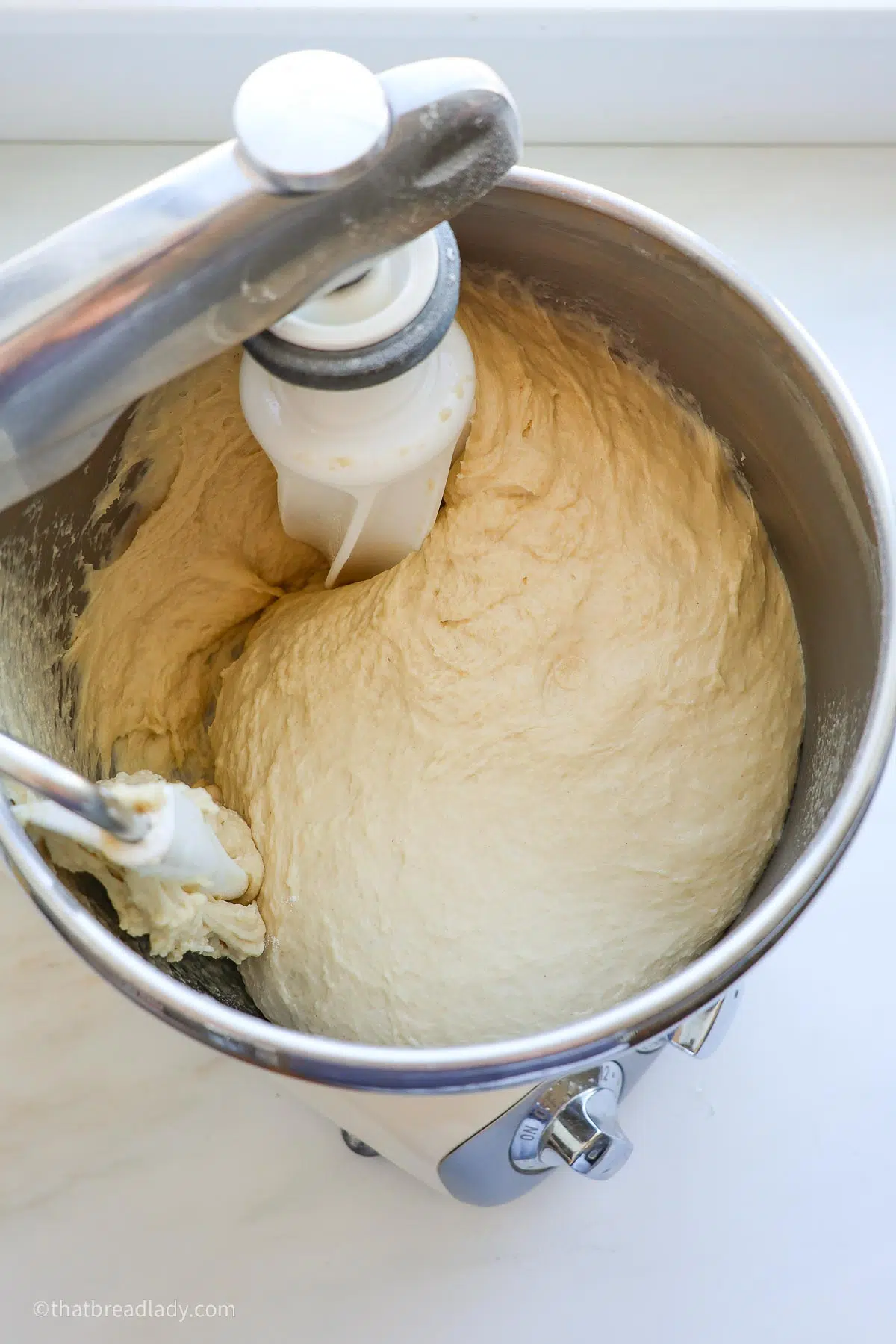
Step 3: Gradually add the rest of the flour. Knead for 8-10 minutes, or until the dough passes the windowpane test.
What is the Windowpane Test?
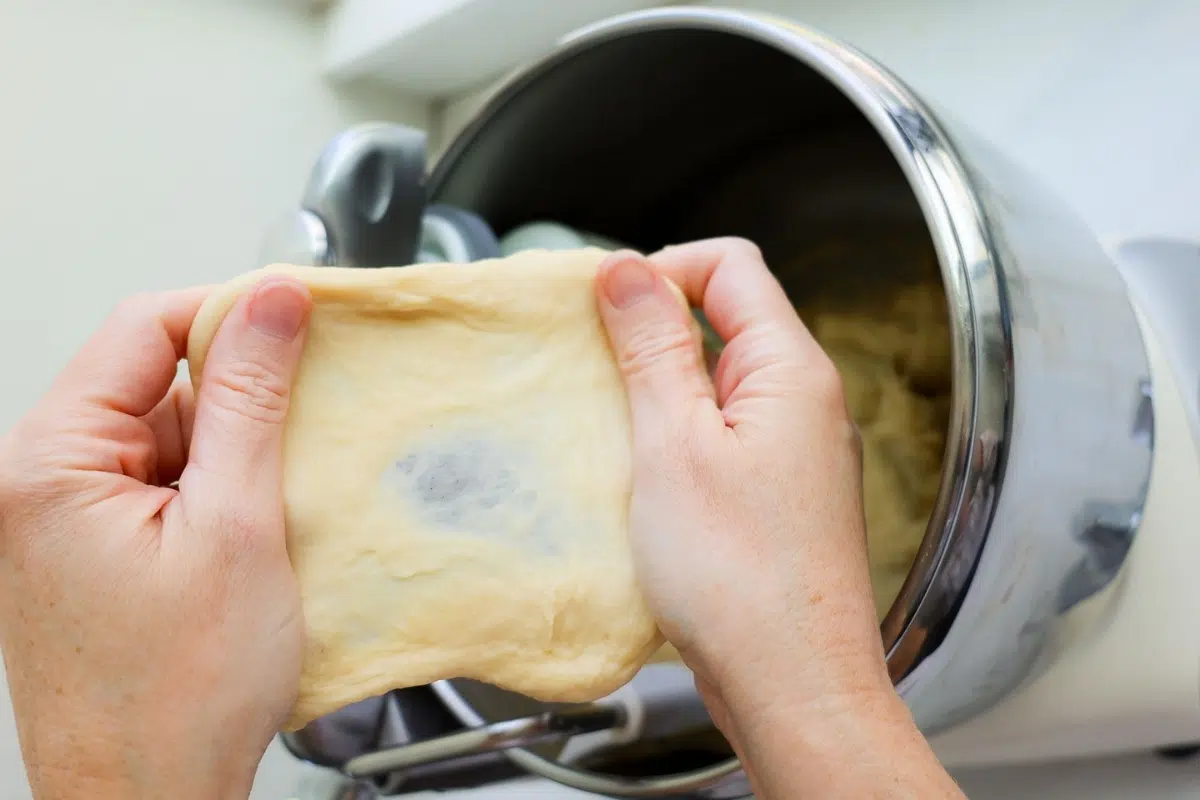
The Windowpane Test
The windowpane test is an easy way to check if your dough has developed enough gluten strength to stretch and hold its shape as it rises and bakes. After kneading the dough:
- Wet your fingers with water and pinch off a small piece of dough.
- Gently stretch the dough between your fingers. If it has been kneaded enough, it should stretch into a thin, almost translucent layer without tearing—you should be able to see light through it, like a windowpane.
- If the dough tears easily before becoming thin, knead it for another 1–2 minutes and test it again.
Baker’s Tip: Stretch the dough slowly and gently. Pulling too quickly can cause even well-developed dough to tear.
Bulk Fermentation
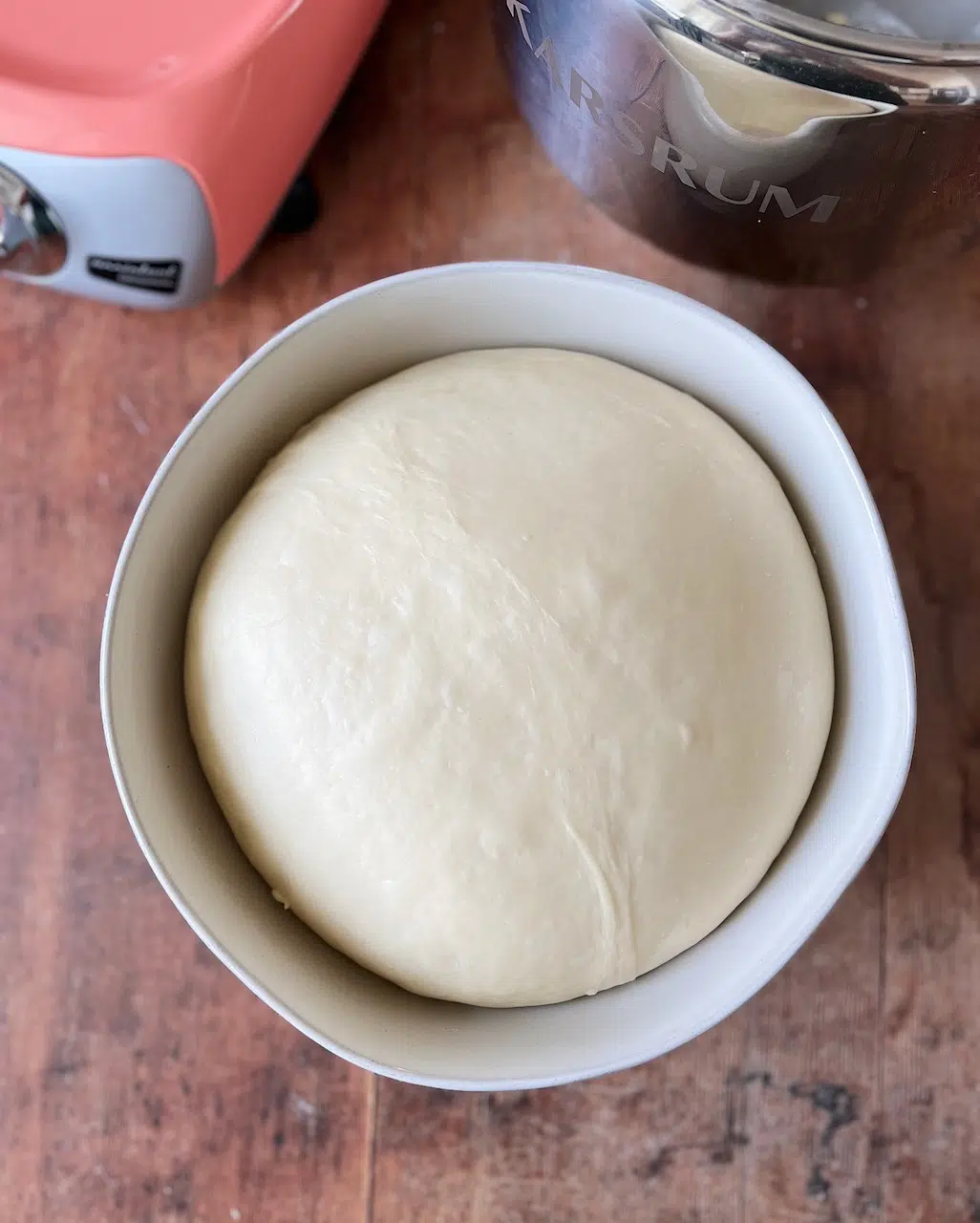
Step 4: Place the roll dough in a large bowl, cover it and let it rise until doubled in size, about 90 minutes. This is “bulk fermentation” – when the dough rises all together, before shaping.
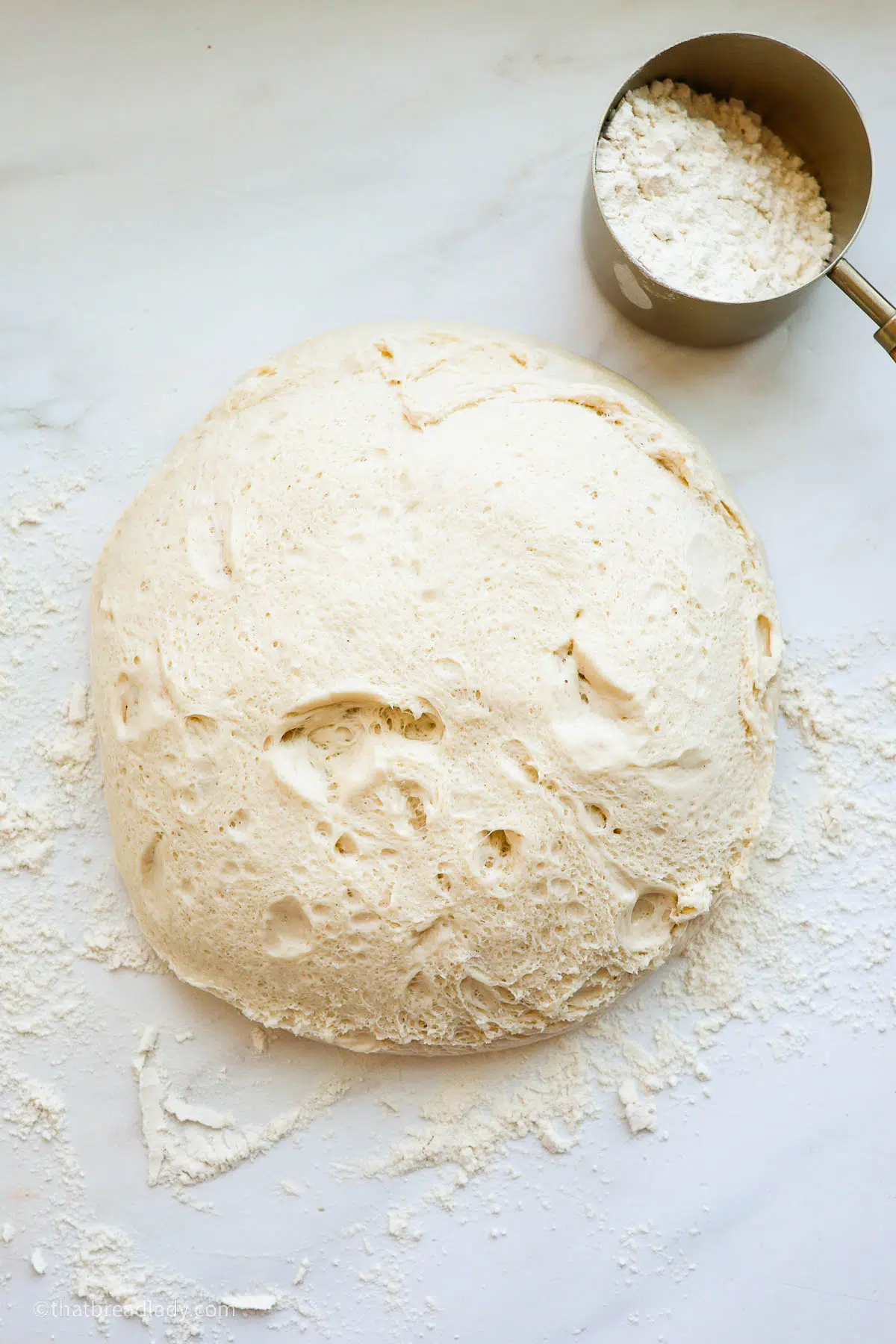
Step 5: Turn the risen dough onto a floured work surface. Flip it and flour all sides of the dough. It should be easier to handle and feel soft and pillowy. Divide it into two equal size pieces.
Shaping
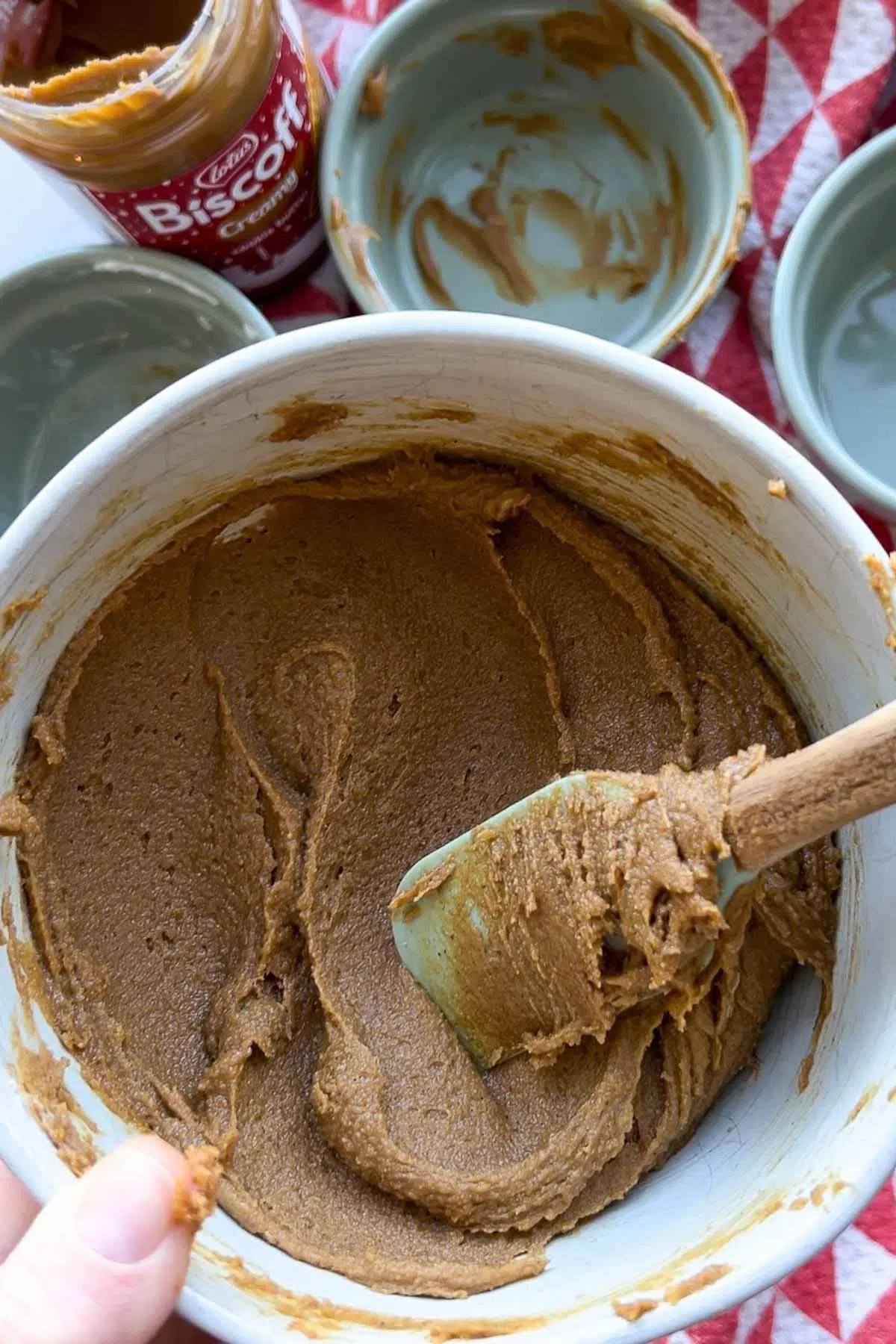
Step 6: In a small bowl, combine the cookie butter with butter (to keep it creamy as it bakes, and make it more spreadable), brown sugar, and cinnamon.
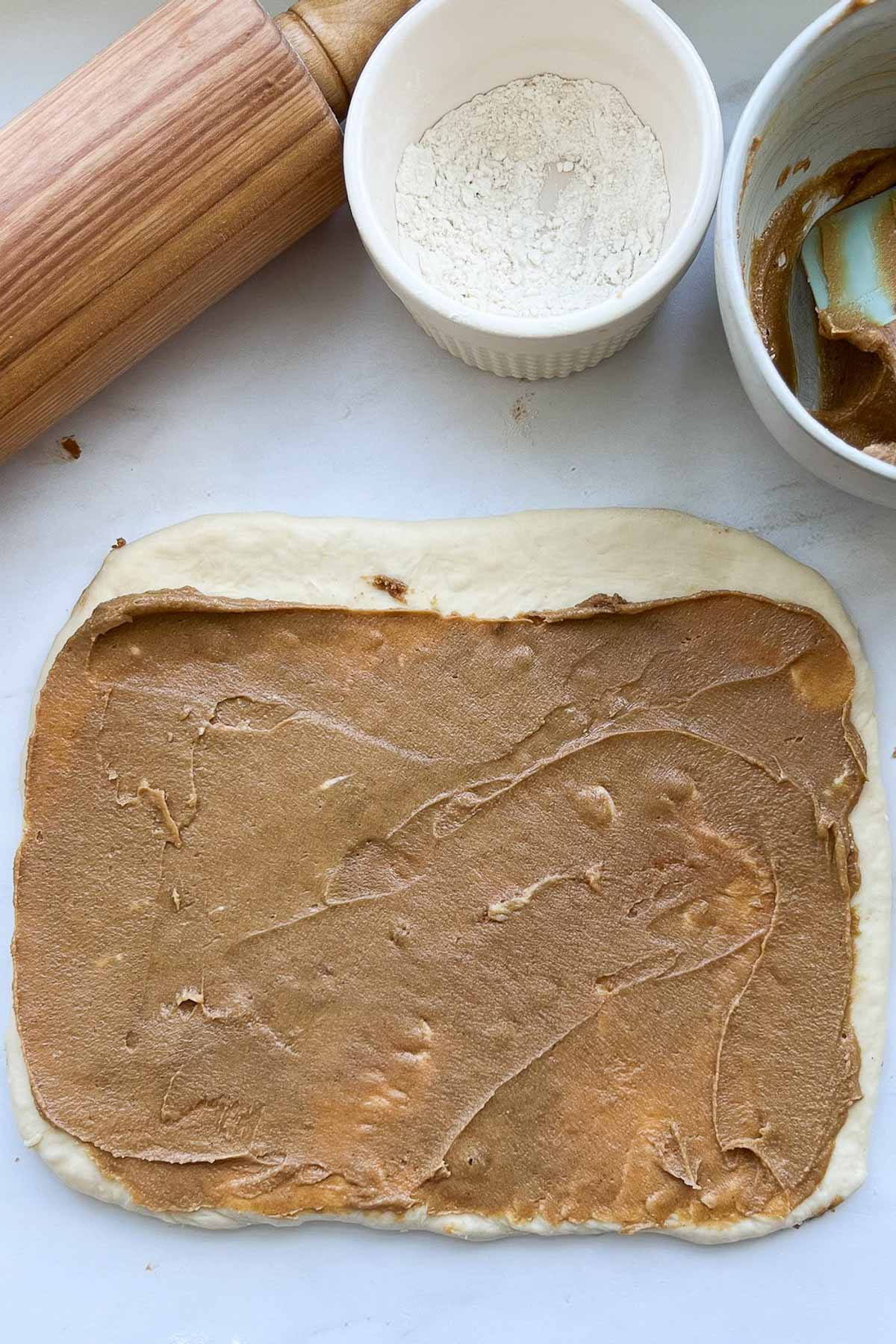
Step 7: Roll each piece of dough to a rectangle, about 10×18-inches (25×45-cm). Spread the Biscoff filling over the dough, leaving a small, clean border at the top.
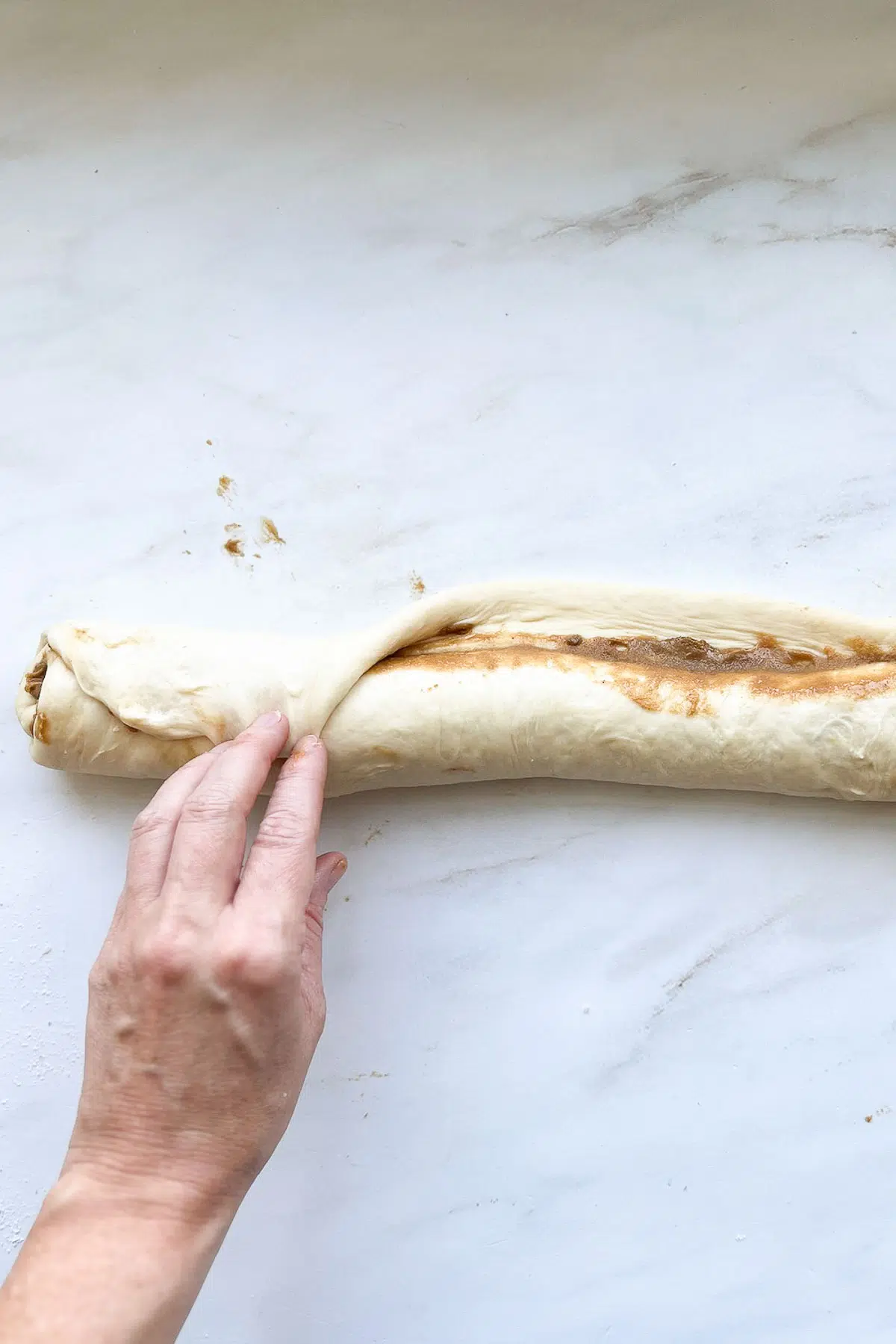
Roll the dough up tightly, pinching the end seam to the roll.
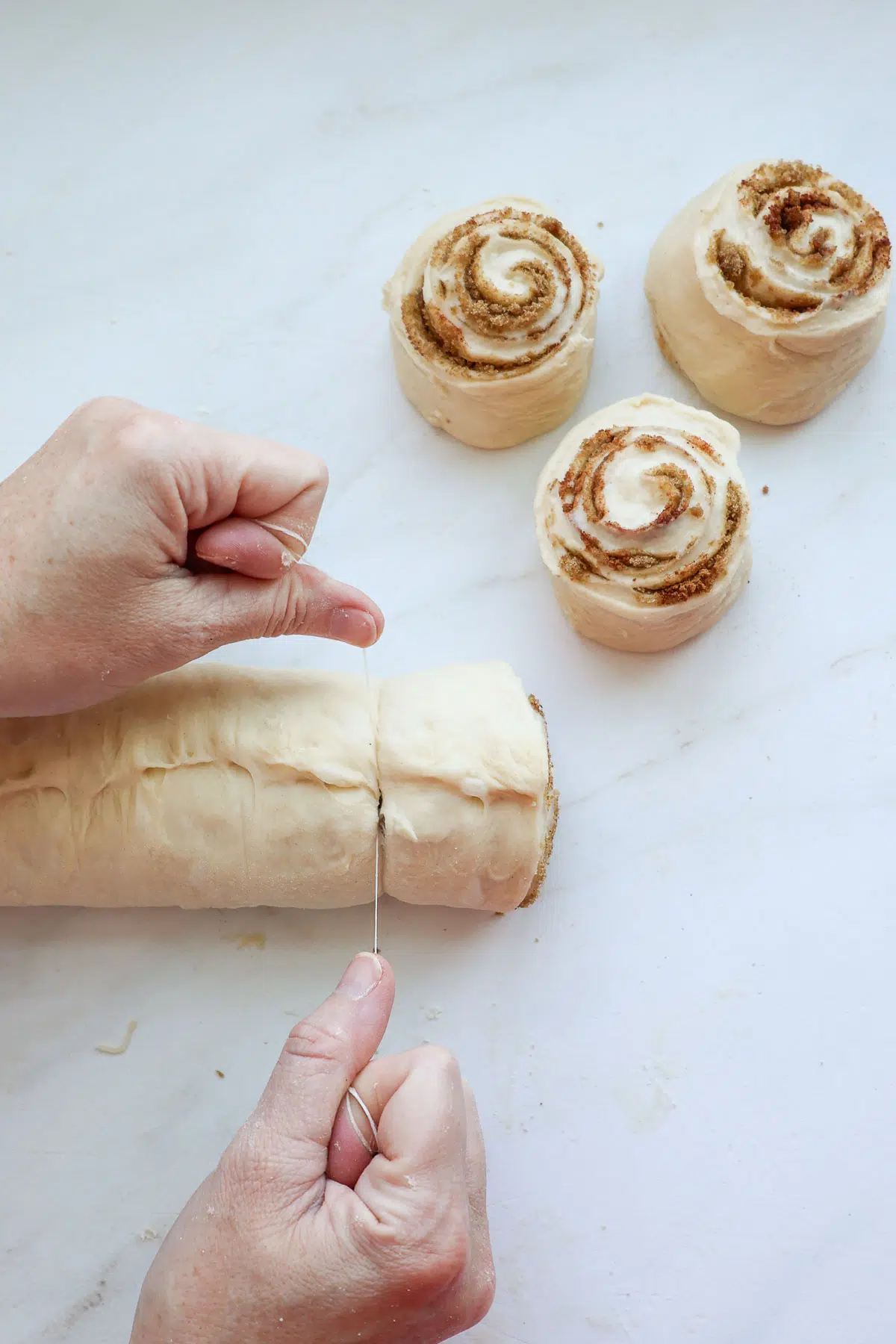
Use dental floss or baker’s twin to cut 9 rolls from each log, each about 2 inches (5-cm). To cut with floss, slide it under the roll, bring the two ends up and cross them over, and give it a gentle tug, cutting through the dough. This is my preferred method as it cuts easily without smashing the cinnamon rolls, like a knife can.
Final Proof
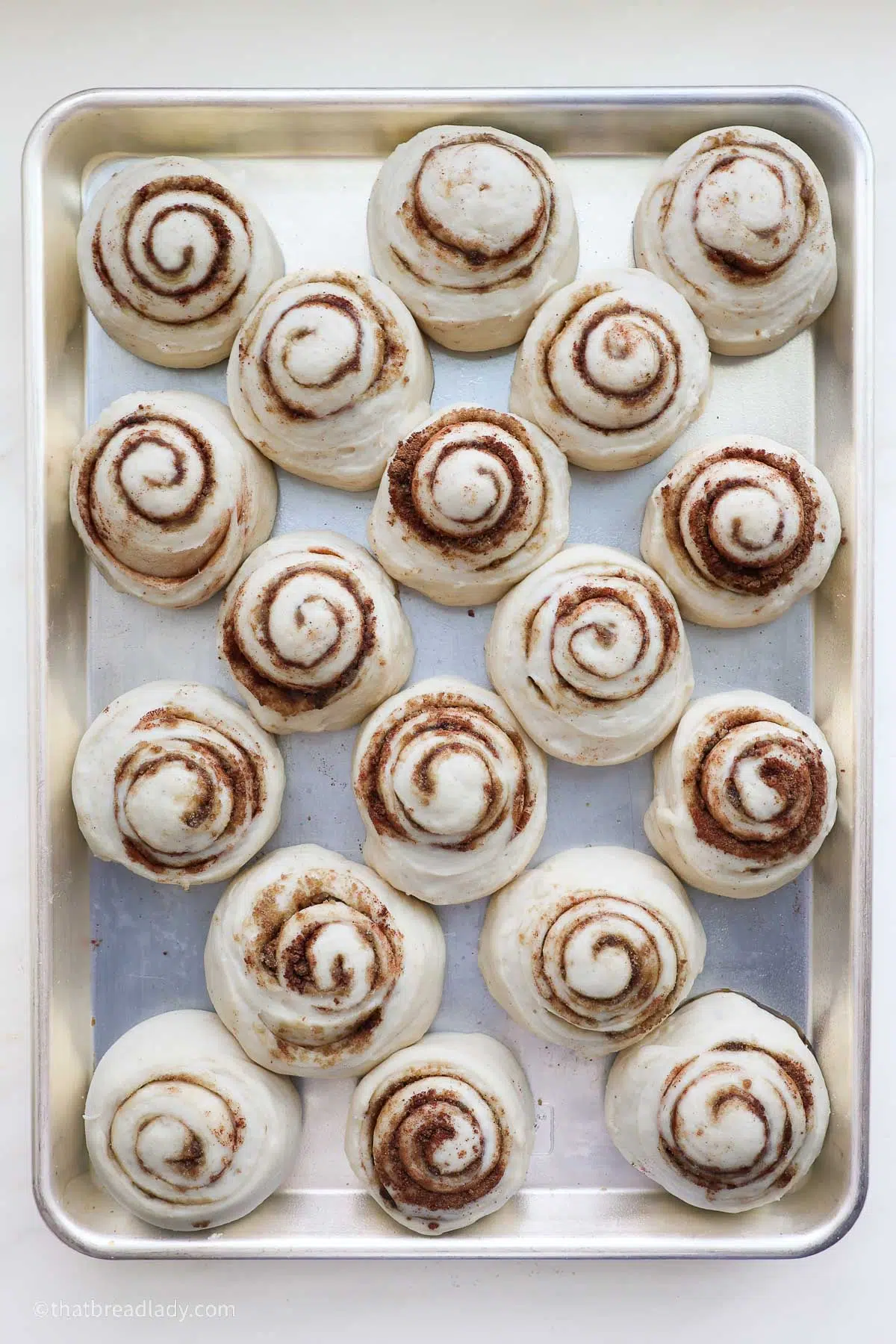
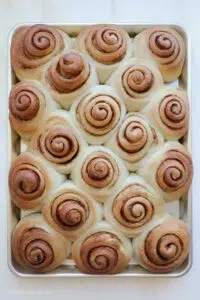
Step 8: Place the Biscoff cinnamon rolls on a greased baking sheet. You should be able to fit all 18 on one pan. It’s okay if they’re touching each other! In fact, that’s even better if they do! They’ll bake upwards instead of outwards.
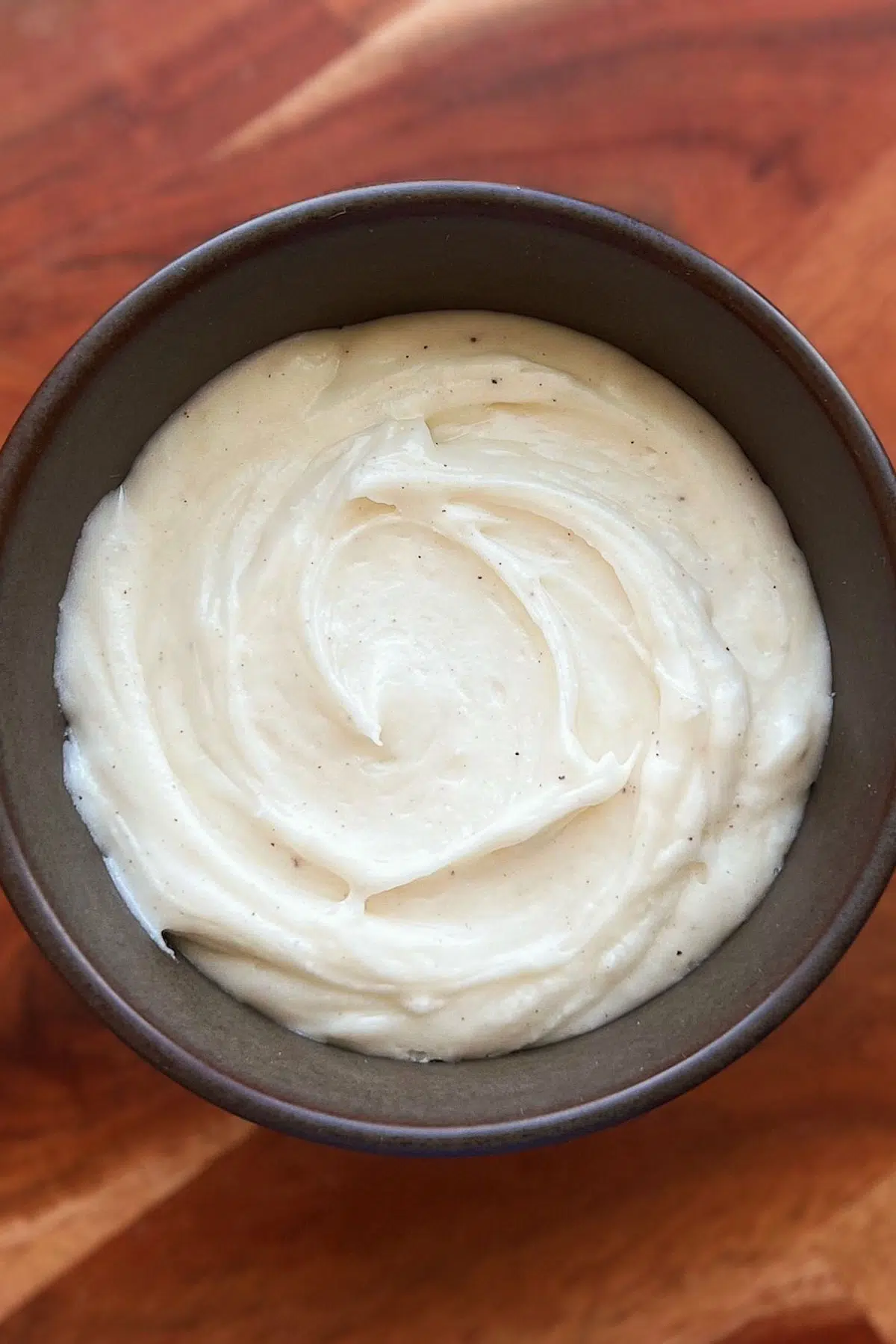
Step 9: As the rolls are rising, mix up the brown butter cream cheese frosting. You’ll want to make sure it’s ready to use when the cinnamon rolls come out of the oven.
When are they ready to bake?
Allow your rolls to get nice and puffy. You can use something called the Poke Test to know when your bread or cinnamon rolls are ready to bake. Flour your finger tip and gently poke the side of one of the rolls. You’ll see one of three results:
- If it doesn’t leave an indent, it needs more time to rise.
- If it leaves an indent that never fills back in, and the dough feels very weak, it has overproofed. Bake them right away.
- If it leaves an indent that slowly fills back in, the dough feels fluffy and bounces back, it’s ready to bake.
The Poke Test is something you can use for all different types of yeasted bread doughs like Honey Whole Wheat Bread or Parker House Dinner Rolls.
Bake and Frost
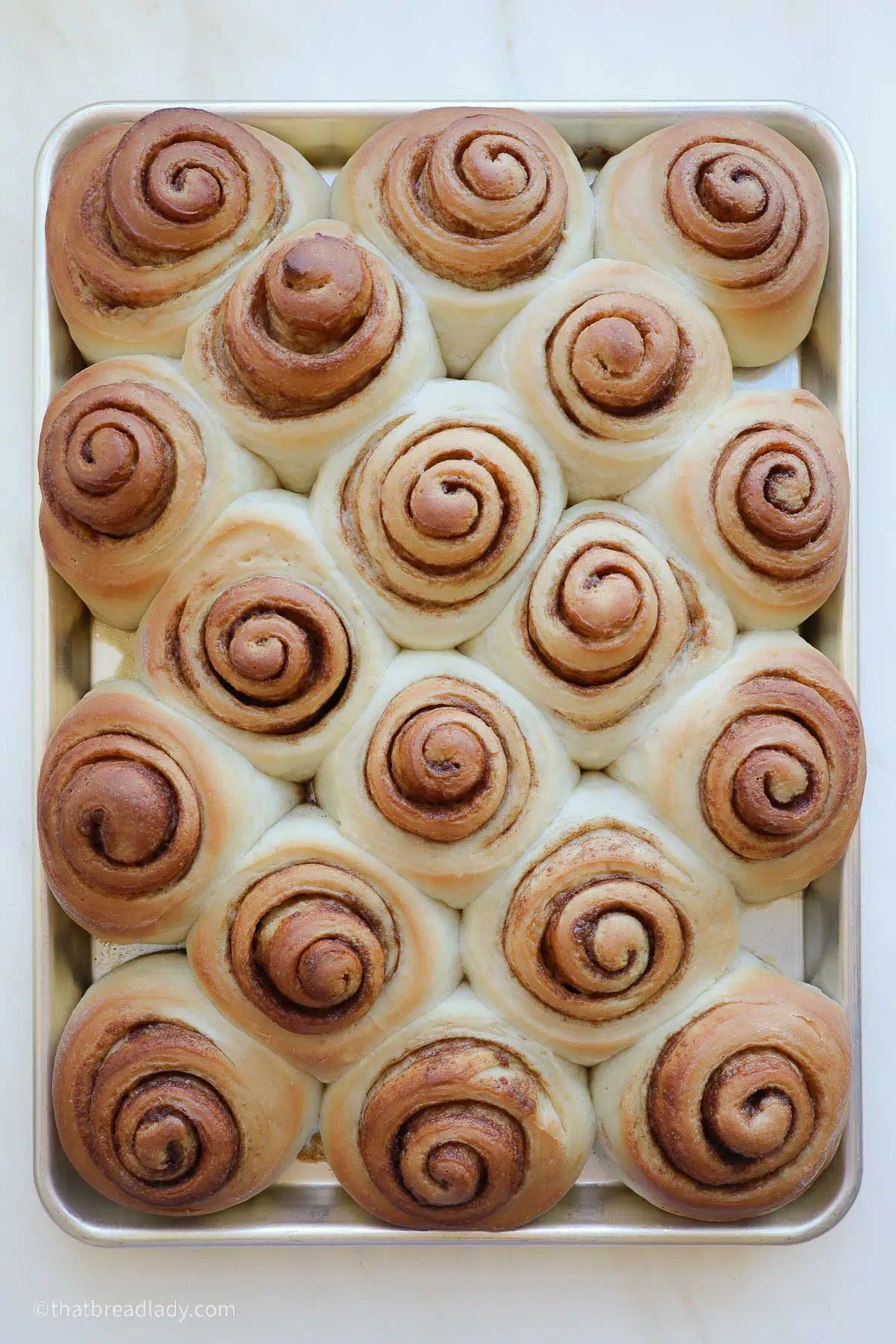
Step 10: Bake at 350°F/175°C for 22-26 minutes, until golden brown, and the internal temperature of the rolls reaches 200°F/90°C.
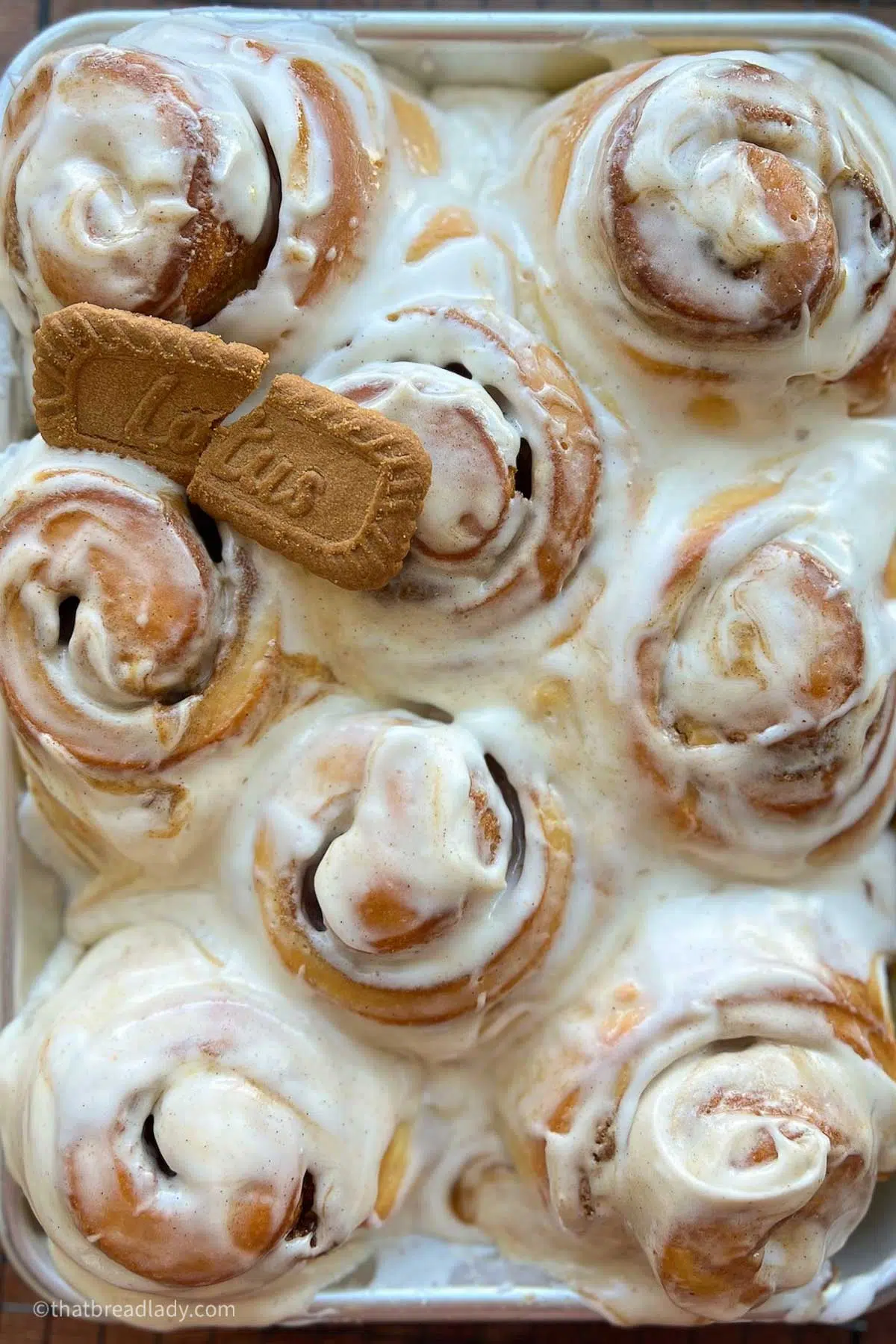
Allow the cinnamon rolls to cool for at least 15 minutes before icing. You want them to still be warm, but not so hot that it melts the frosting.
How to make Biscoff Cinnamon Rolls Ahead of Time
- Freeze unbaked rolls: After rolling up and placing the rolls on a nonstick cookie sheet, put the entire pan in the freezer and allow the rolls to freeze for 24 hours. Once frozen, remove the sheet pan and store in a zip top bag, in the freezer for up to 4 weeks. When baking frozen rolls, remove them from the freezer bag and place on a baking sheet. Lightly cover with plastic wrap. Allow them to rise at room temperature for 3-5 hours, or until puffy, then bake as usual. You could also let them thaw on a baking sheet in the refrigerator overnight. Remove them from the refrigerator and let them sit at room temperature for about 30 minutes while you preheat your oven.
- Make overnight cinnamon rolls: After kneading the dough, let it rest for 15 minutes and then roll out the cinnamon rolls, skipping the first rise (bulk fermentation). Lightly cover the pan with plastic wrap (spray it with nonstick spray to keep it from sticking to the rolls). Place it in the refrigerator to proof overnight, ideally no longer than 10 hours as they will still rise in the refrigerator and can easily over proof if left for too long. Bake as directed.
- Make the dough the night before and roll up in the morning: Skip the first rise on the countertop – the dough will rise in the refrigerator overnight. In the morning let the dough warm up at room temperature for about 15 minutes before rolling up. They will rise within 45 minutes and be ready to bake and frost!
Frequently Asked Questions
They weren’t proofed long enough. When they enter the hot oven, the yeast can rise too quickly at first and then fall back down when cooled, resulting in a cinnamon roll that has gapping. Try letting them rise until puff and they pass the Poke test.
Store your cinnamon rolls in an airtight container or cover with foil to keep them from drying out. They will stay fresh for up to 3-5 days.
MADE THIS RECIPE AND LOVED IT? 🤎 Please leave a 5-star⭐️ rating and comment below! I love hearing how my recipes turned out for you! It impacts my blog so much and allows me to keep sharing helpful tips and delicious recipes with you!
Biscoff Cinnamon Rolls Recipe
Biscoff Cinnamon Rolls
Video
Ingredients
Brown Butter Cream Cheese Frosting:
- 56 g unsalted butter (¼ cup) cubed
- 4 ounces cream cheese (113 g)softened
- 1 teaspoon pure vanilla extract
- 1 pinch fine sea salt
- 1 pound powdered sugar (454 g) divided
- 2-3 tablespoons milk as needed
Dough Ingredients:
- 454 g warm water (2 cups) about 105°F/40°C
- 28 g nonfat powdered milk (¼ cup)
- 43 g instant boxed potato flakes (½ cup)
- 100 g granulated sugar (½ cup)
- 12 g instant yeast* (4 teaspoons)
- 8 g salt (1 ½ teaspoons)
- 56 g unsalted butter (¼ cup) softened
- 92 g butter flavored vegetable shortening (½ cup)
- 2 large eggs (100 g) room temperature
- 720 g bread flour (6 cups) divided
- 120 g heavy cream room temperature
Filling Ingredients:
- 200 g Biscoff cookie butter (⅔ cup)
- 75 g unsalted butter (⅓ cup) softened
- 165 g dark brown sugar (¾ cup) packed
- 8 g ground cinnamon (1 tablespoon)
- Optional: 2-3 Biscoff Lotus cookies for garnishing
Instructions
Prepare the Brown Butter Cream Cheese Frosting:
- Add the cubed butter to a small light colored saucepan. Melt on medium low heat. Allow it to come to a low simmer. Stir frequently to allow the butter to cook evenly. After about 4-5 minutes, you'll see the butter start to brown and give off a slightly nutty aroma. Once you see small, golden brown speckles, and the butter turns a light amber color, remove the pan from the heat (avoid over browning).56 g unsalted butter
- Immediately pour the butter into a heat safe bowl and refrigerate until it becomes solid, about 2 hours. Allow the butter to sit at room temperature for 15 minutes before using. Then break it up into smaller chunks with a spoon.
- In the bowl of a stand mixer, with the paddle attachment, cream together the brown butter and cream cheese until smooth, about 2 minutes.4 ounces cream cheese
- Add the vanilla and salt. Add half the powdered sugar. Mix on low until smooth. Mixture will be thick. Add 2-3 Tablespoons of milk to thin the mixture. Continue to add the remainder of the powdered sugar, alternating with just enough milk to yield a creamy frosting. Cover and set aside.1 teaspoon pure vanilla extract1 pinch fine sea salt1 pound powdered sugar2-3 tablespoons milk
Prepare the dough:
- In the bowl of a stand mixer, add the warm water, powdered milk, potato flakes, sugar, yeast, salt, softened butter, shortening, eggs, and half the flour. With the dough hook attachment, mix on low speed until smooth and fully combined.454 g warm water28 g nonfat powdered milk43 g instant boxed potato flakes100 g granulated sugar12 g instant yeast*8 g salt56 g unsalted butter92 g butter flavored vegetable shortening2 large eggs360 g bread flour
- While on low speed, gradually add the remaining flour. Continue to mix on low until the flour is completely incorporated. Knead on low speed about 8 minutes, until the dough becomes cohesive, and cleans the sides of the bowl. It should pass the windowpane test (stretch a piece of dough apart – if it's elastic and doesn't tear, it's done kneading).360 g bread flour
- Remove the dough from mixer and place in a greased bowl. Turn the dough, coating all sides in the non-stick spray. Cover with clean kitchen towel or plastic wrap. Let rise in a warm place until doubled in size, about 90 minutes.
Prepare the filling:
- In a small bowl, combine all the ingredients for the filling with a spoon or rubber spatula. Stir until fully combined and creamy.200 g Biscoff cookie butter75 g unsalted butter165 g dark brown sugar8 g ground cinnamon
Shape the rolls:
- Divide dough into two equal portions (about 28-30 ounces each). Round each portion to an oval shaped piece of dough by pulling the dough and tucking it underneath itself. This will make it easier to roll out into a rectangle.
- Flour the work surface and roll dough out to a rectangle, about 10 x 18-inches. Spread half of the Biscoff Filling on the dough, leaving a 1-inch border on the top edge of the rectangle. Leaving this border will help in sealing the dough shut when rolled up.
- Start with the long side closest to you, and working from left to right, begin to roll up the dough. Tug and pull as you go, which will tighten the roll and make more swirls. Once it's all rolled up, pinch the seam shut by pinching the edge of the dough to the roll.
- Cut 9, 2-inch cinnamon rolls (I find using dental floss makes the cleanest cuts!).
- Place the Biscoff cinnamon rolls on a 13 x 18-inch baking sheet, sprayed with nonstick spray. Space the rolls about 2 inches apart. Roll out, fill, and shape the second piece of dough. You should be able to fit all 18 cinnamon rolls on one half size sheet pan.
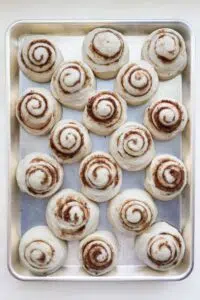
- Cover and let rise until puffy (see notes for Poke Test), about 45-60 minutes. Towards the end of the rise time, preheat oven to 350°F/177°C. Just before baking, pour the room temperature heavy cream over the tops of the rolls.120 g heavy cream
Bake:
- Bake for 24-28 minutes or until edges are medium golden brown and the internal temperature of the rolls is 200°F/90°C. Place pan on a wire cooling rack and let cool for 15 minutes.
Frost:
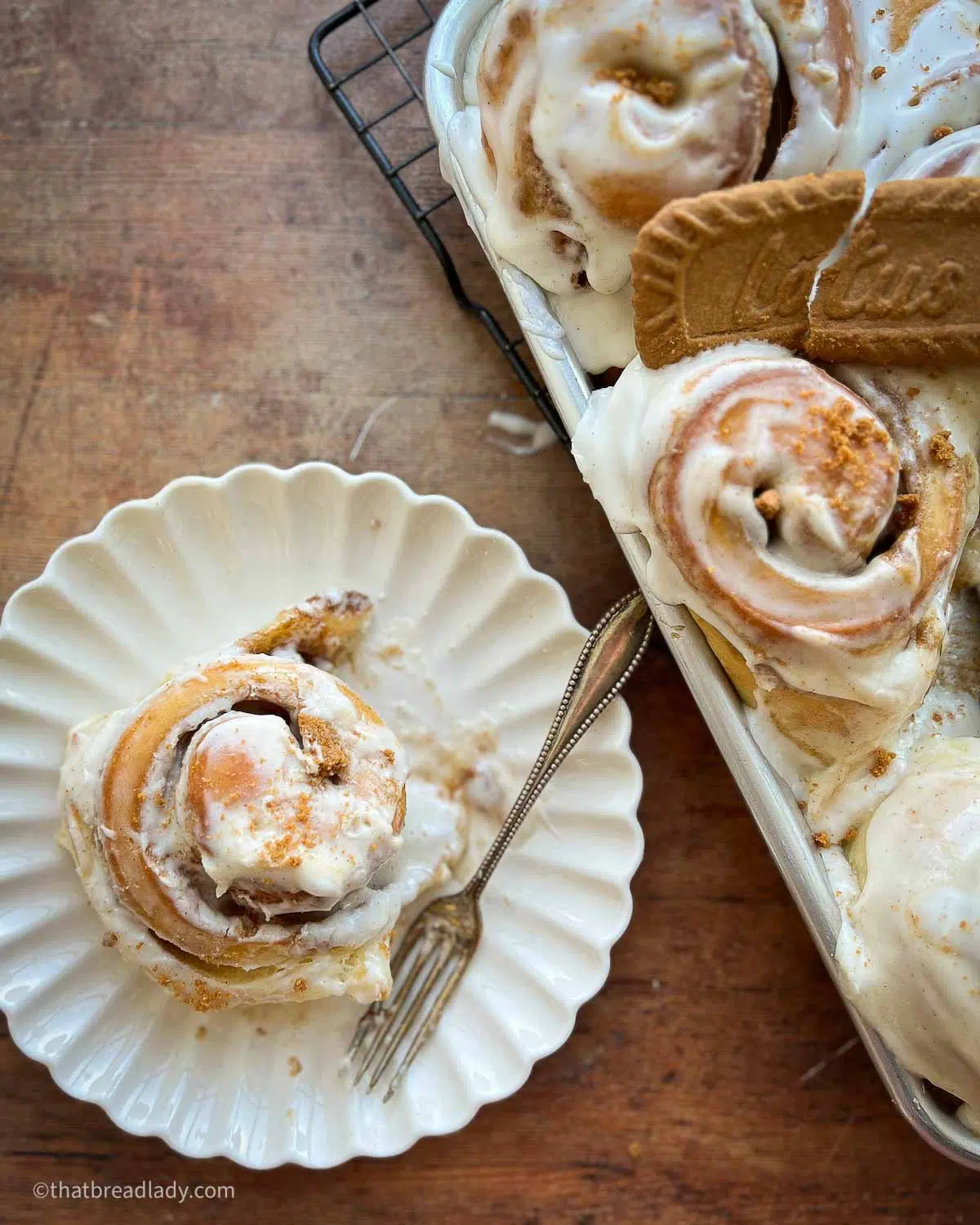
- Spread the frosting over the warm rolls. Allow them to sit 5-10 more minutes, letting the frosting set up. Sprinkle with crushed Biscoff Lotus cookies. Serve and enjoy!
Notes
- *You can replace the instant yeast with active dry yeast – be sure to proof it first.
- Poke Test: When trying to decide if dough has risen enough for final proof, gently press on the side of the loaf with your fingertip. It should leave an indent that slowly springs back. That indicates the dough has risen enough and is ready to bake. If it does not leave an indent, it needs more time to rise. If it leaves and indent that never springs back it has risen too long.
-
-
- Freeze unbaked rolls: After rolling up and placing the rolls on a nonstick cookie sheet, put the entire pan in the freezer and allow the rolls to freeze for 24 hours. Once frozen, remove the sheet pan and store in a zip top bag, in the freezer for up to 4 weeks. When baking frozen rolls, remove them from the freezer bag and place on a baking sheet. Lightly cover with plastic wrap. Allow them to rise at room temperature for 3-5 hours, or until puffy, then bake as usual. You could also let them thaw on a baking sheet in the refrigerator overnight. Remove them from the refrigerator and let them sit at room temperature for about 30 minutes while you preheat your oven.
- Make overnight cinnamon rolls: After kneading the dough, let it rest for 15 minutes and then roll out the cinnamon rolls, skipping the first rise (bulk fermentation). Lightly cover the pan with plastic wrap (spray it with nonstick spray to keep it from sticking to the rolls). Place it in the refrigerator to proof overnight, ideally no longer than 10 hours as they will still rise in the refrigerator and can easily over proof if left for too long. Bake as directed.
- Make the dough the night before and roll up in the morning: Skip the first rise on the countertop – the dough will rise in the refrigerator overnight. In the morning let the dough warm up at room temperature for about 15 minutes before rolling up. They will rise within 45 minutes and be ready to bake and frost!
-
I make these for my bake stand, and they ALWAYS sell out! My daughter wants them instead of a cake for her birthday and she said she would fight a full-grown man for them if they were the last package at a store! lol!!
Haha! That’s incredible! Yes, I have a child that is obsessed with cinnamon rolls and he says these are better than my regular homemade cinnamon rolls! I’m so glad you’re enjoying the recipe! Thank you for your review!
These were so yummy!! I even like them better than regular cinnamon rolls!
Is it 1 tablespoon plus 1 teaspoon OR 1 tablespoon plus 2 teaspoons? Thanx for your help
Thank you for catching that typo. I just updated the recipe. For the yeast, it’s 4 teaspoons (or 1 Tablespoon, plus 1 teaspoon). Hope you enjoy Ginny!
i made these for my Christmas morning breakfast. They great flavor and texture but i found that 22 mins baking time is not long enough. I didn’t think i made them too big but next time i will make them smaller
So glad you enjoyed these! Every oven bakes a bit differently, but now it’s great for you to know they need to bake a bit longer. I have found that as long as I let the edges get a medium light golden color, they are baked all the way through. Hope you continue to enjoy!