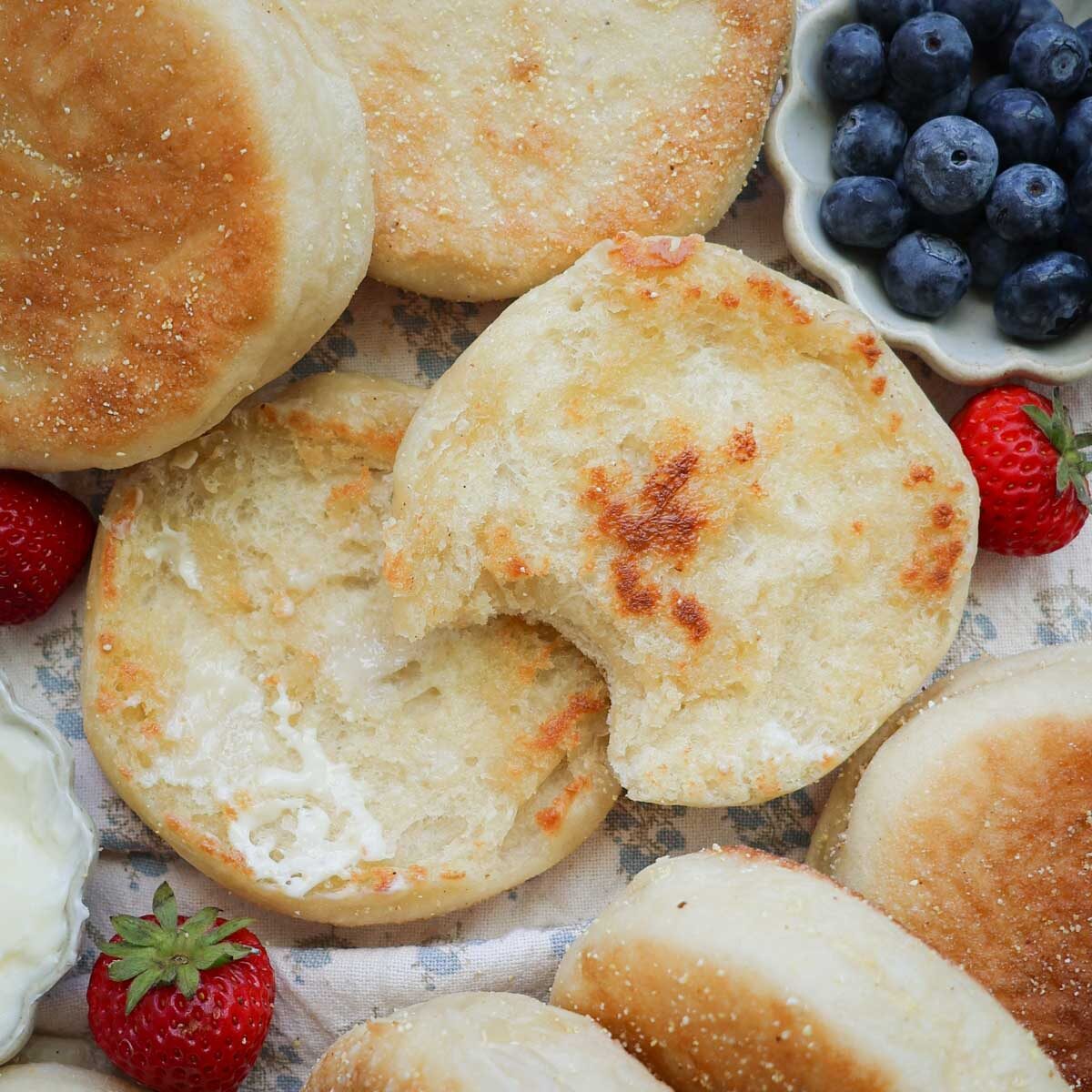
Sourdough English Muffins
These delicious sourdough English muffins are so much better than store bought! Use your ripe sourdough starter to make this soft and fluffy dough. Cook them in a cast iron skillet in homemade clarified butter for an amazing rich flavor! The sourdough English muffins are tall, fluffy and so delicious! You'll be making them again and again! (this is an updated recipe, using sourdough starter instead of instant yeast)See my recipe post for a sample timeline to make this recipe.
Print
Pin
Servings: 12 English Muffins
Ingredients
Dough
- 256 g water room temperature (around 76°F)
- 120 g active sourdough starter
- 18 g extra virgin olive oil
- 7 g fine sea salt
- 410 g all-purpose flour
Clarified Butter
- 113 g unsalted butter
Additional ingredients:
- 60 g yellow cornmeal
Instructions
Feed your sourdough starter
- I suggest doing this in the morning. About 12 hours before you want to mix the dough, feed your starter with a 1:6:6 ratio, making enough for the recipe plus more to feed your main starter. (Example: feed your starter 11g starter, 66g flour, 66g water - giving you 143g.)
Make the Clarified Butter
- This should be made and chilled at least 4 hours before cooking the English muffins. Melt the cubed butter in a saucepan over low to medium-low heat. Without stirring, melt butter until a white foamy layer forms on top. Remove from heat. With a spoon, skim off the top foamy layer, leaving the clear yellow layer of butter underneath. Avoid browning the butter. Let sit for 5 minutes. Line a wire sieve with a dampened, wrung out piece of cheesecloth and set over medium bowl. Pour the clear, yellow, melted butter onto the lined sieve. Leave any milky residue behind in the sauce pan. Discard the residue. Store the clarified butter in a covered container and refrigerate until it becomes a solid form, about four hours.
Mix the dough
- I suggest mixing the dough at night, around 9:00 pm. To the bowl of a stand mixer, add the water, sourdough starter, olive oil, salt, and half the flour. Mix on low speed using the dough hook attachment. Mix about 1-2 minutes, until all the ingredients are incorporated and the dough is smooth. Gradually add the remaining flour and mix until fully combined.
- Knead the dough on low speed for 5 minutes. The dough will be soft and feel slightly tacky. If the dough feels very wet and sticky, let it rest for 10 minutes. Come back to it and tap on it with your finger. If it still feels wet, mix in 1-2 Tablespoons of flour and test again. Add more flour if necessary, but try to avoid adding too much flour - the texture will improve during bulk fermentation.
Bulk Fermentation
- Place dough in a large bowl. Cover and let rest 30 minutes.
- Stretch & Fold 1: Stretch one side of the dough up and fold over onto itself. Turn the bowl 90 degrees and stretch and fold again. Repeat on all 4 sides of the dough. (You can also use a coil fold if you prefer.) Cover and let rest 30 minutes.
- Stretch & Fold 2: Perform a second series of stretch and fold. (You can also use a coil fold if you prefer.) Cover and let rest for the remainder of bulk fermentation.
- Allow the dough to rise about 50% in volume. It should have small bubbles throughout with a few on top. It should easily pull away from the sides of the bowl. If you gently press on it with your fingertip, it should leave an indentation that slowly springs back. With a dough temperature of 78°F, this may take around 7-8 hours. Warmer conditions will speed up this process, and cooler conditions will slow it down.
Divide & Shape
- Place the dough onto a lightly floured work surface. Do not depress the dough. Divide into 12 equal pieces. Shape each piece into a round ball by pinching opposite sides together at the center. Turn the dough over so that the seam side is down. Cup your hand and gently round the dough by rolling it in a circular motion. When the outside of the dough smooths and tightens, gently flatten it to a small disc. Place each dough disc on the parchment and flip so each side is coated with cornmeal. Cover with a towel and let it rise in a warm place until they have increased in volume by 50%, about one hour.
Cook the English Muffins
- Melt 2 Tablespoons of clarified butter into a large (preferably cast iron) skillet on low to medium-low heat. Add 3-4 English muffins to the pan and cook until the bottom is golden, about 3 minutes. Flip and cook on the other side for 3 minutes. Keep the heat low enough so that they don't burn before the centers are fully cooked. The interior of the English muffin should be at least 195°F. After cooked, place on a baking sheet lined with paper towels to drain the excess butter. Add more butter to the skillet and repeat until all of the English muffins are cooked. Allow them to cool for at least 30 minutes before splitting apart and serving - they are continuing to cook internally.
- To split in half, use a fork to poke holes around the center of the English muffin and pull apart with your fingers - this will give you all of those delicious nooks and crannies!
- Toast or enjoy fresh! They're best enjoyed the same day.
Notes
- Store leftovers in an airtight container, lined with a paper towel. Store at room temperature for up to 3 days.
- You can freeze baked and cooled English muffins in an airtight container for up to one month. Allow to thaw at room temperature overnight.
- Keep extra clarified butter, covered, in the refrigerator for up to 1 month. Use for other things like sauteing vegetables.
- You can make sourdough discard English muffins by using discard that has been fed within the past week. If it's on the runnier side, add 1/2 tsp instant yeast to the dough to help it rise.
Nutrition
Serving: 1g | Calories: 224kcal | Carbohydrates: 30g | Protein: 4g | Fat: 10g | Saturated Fat: 5g | Polyunsaturated Fat: 1g | Monounsaturated Fat: 3g | Trans Fat: 0.3g | Cholesterol: 20mg | Sodium: 229mg | Potassium: 55mg | Fiber: 1g | Sugar: 0.2g | Vitamin A: 236IU | Calcium: 8mg | Iron: 2mg
