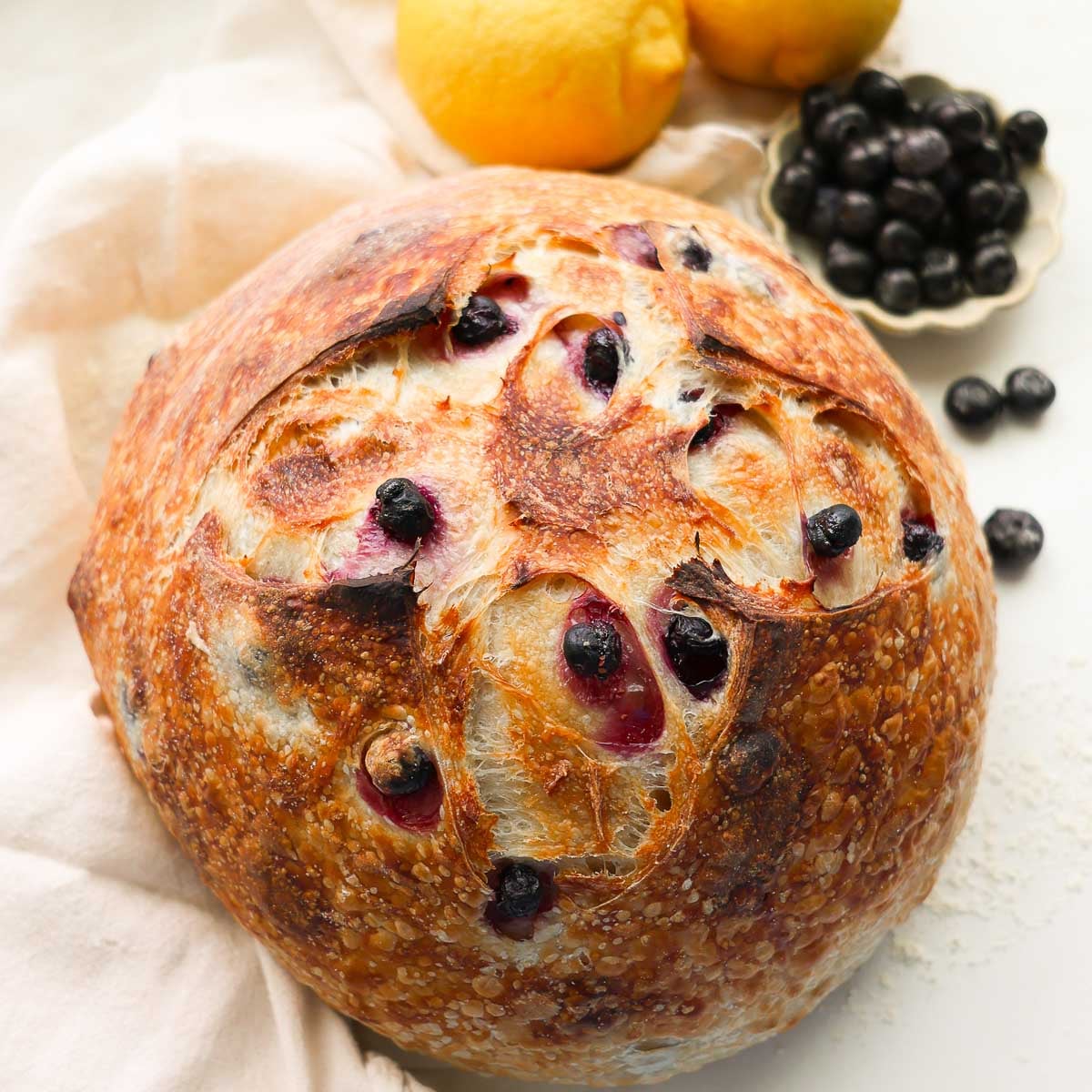
Lemon Blueberry Sourdough Bread
This Lemon Blueberry Sourdough Bread is bursting with bright citrus aroma, juicy blueberries, and that perfectly tangy sourdough flavor in every bite. You will love its soft, flavorful crumb and crisp golden crust—it’s the kind of loaf that feels special enough for brunch but cozy enough to enjoy every day. This recipe makes 1 Loaf, or 16 slices.
Print
Pin
Servings: 16 slices (1 loaf)
Equipment
Ingredients
Levain
- 12 g sourdough starter
- 60 g bread flour (½ cup)
- 60 g water, room temperature, 74°F/23°C (¼ cup)
Lemon Blueberry Sourdough Bread
- 4 g lemon zest (2 teaspoons)
- 50 g sugar (¼ cup)
- 350 g water, divided, room temperature, 74°F/23°C (around 1½ cups)
- 500 g bread flour (around 4¼ cups)
- 10 g fine sea salt (2 teaspoons)
- 130 g fresh blueberries (1 cup)
Instructions
Prepare the Levain (the night before)
- To a clean jar, add the ingredients for the Levain. Mix until combined and no dry bits of flour remain. Cover and let rise at room temperature, overnight, for about 12 hours or until it has reached its peak. It should more than double in size and be thick and bubbly when using it for mixing the bread.12 g sourdough starter60 g bread flour60 g water, room temperature, 74°F/23°C
Mix the Dough (the next morning)
- To a small bowl, add the lemon zest and granulated sugar. Rub it together with your fingers to release the lemon flavor. Set aside.4 g lemon zest50 g sugar
- In a large bowl, add 100g of the levain and 330g of the water (reserve the remaining 20g of water for later). Mix it together with your hands to break up the levain. Add the lemon sugar mixture and the bread flour. Mix with a Danish dough whisk or pinch it together by hand. Make sure no dry bits of flour remain. Cover and let rest 30 minutes.330 g water, divided, room temperature, 74°F/23°C100 g levain500 g bread flour
- Sprinkle the salt and the remaining 20g of water over the dough. Pinch it together with your fingers to fully incorporate. Cover and let rest 30 minutes.10 g fine sea salt20 g water
Stretch and Fold
- Fold 1: Remove the cover from the bowl. Wet your fingers with water to prevent the dough from sticking as you handle it. Stretch one side of the dough up and fold it over. This is called a stretch and fold. Rotate the bowl a quarter of a turn and repeat. Continue until you’ve performed a stretch and fold on all four sides of the dough. Cover the dough and let it rest 30 minutes.
- Fold 2: Add the blueberries over the dough and perform a second set of stretch and folds. This will help to distribute the blueberries all throughout the dough. Cover and let rest 30 minutes. 130 g fresh blueberries
- Fold 3: Perform a third and final set of stretch and folds to the dough.
Bulk Fermentation
- Cover the dough and let it bulk ferment (rise) until it has risen about 50% in volume. It should be domed with a few bubbles on top and throughout the dough. At a dough temperature of around 78°, bulk fermentation can take 2-4 additional hours, depending on the warmth of your kitchen.
Shape
- Prepare a 9-inch round proofing basket with a linen liner. Lightly dust with flour. Set aside.
- Lightly flour your work surface. Turn the dough out of the bowl. Shape a round loaf by pulling opposite sides of the dough towards the center and overlap them. Repeat all around the dough, forming a tight, round loaf. Turn the loaf over and round it out a few times, tightening the outside of the loaf. Scoop it up and flip it over, into the proofing basket. The seam side is now facing up.
Final Proof (overnight)
- Cover the loaf with a plastic shower cap or bread bag and let cold proof in the refrigerator for 12 to 24 hours.
Bake (the next day)
- Place a Dutch oven on the middle rack of the oven and preheat to 450°F. Preheat for at least 30 minutes. Remove the loaf from refrigerator. Uncover and place a piece of parchment paper over top. Holding the parchment with the bowl, flip it over, releasing the loaf from the basket. The loaf should now be smooth side up on the parchment paper.
- Using a bread lame or sharp knife, cut an X on top of the loaf, about 1/2-inch deep. Lift the loaf with the parchment into the hot Dutch oven. Replace the lid and place it in the oven.
- Bake with the lid on for 35 minutes. Reduce the oven temperature to 425°F and remove the lid. Bake an additional 5-15 minutes, until the loaf is lightly golden brown. It should have an internal temperature of 205°F. Remove the loaf and place it onto a wire cooling rack. Let the loaf cool completely before slicing, at least 2 hours.
Notes
- See my blog post for a recipe timeline and detailed images for this recipe.
- Baking without a Dutch oven: You can bake sourdough without a Dutch oven. The main idea is to create steam in your oven to help it rise nice and tall. You can bake it on a baking sheet or preheated baking stone. Place a deep pan on the bottom of your oven and preheat it with your oven. Carefully add boiling water to the hot pan and close oven door. Let the oven steam up for about 5 minutes before baking the loaf. Bake with the steam for all but the last 10 minutes of the bake time. *To be safe, place a towel over the glass oven door while adding and taking out the hot water.
- Stretch and Folds: You can do coil folds instead of stretch and fold – use whichever technique you prefer.
- Ripe Sourdough Starter: Make sure you use your starter when it’s bubbly and active. For me, I use my starter in the morning at feeding time – I add what I need to my recipe, making sure I have enough left over to feed with.
- Temperature: Both dough temperature and climate temperature play a big role in how your dough develops. My kitchen is usually around 76°F. I use room temperature water…so my dough is typically around 76-78°F. My recipe is written taking these factors into account. Warmer temperatures speed up the fermentation process and colder temperatures slow it down. Depending on your kitchen and water temperature, your dough may develop at a different rate than mine. Use your baker’s intuition to look for the signs of the completion of bulk fermentation.
- Same Day Baking: You can bake this loaf the same day. Instead of chilling after shaping, let it rest at room temperature for about 1-2 more hours. It should rise a bit more and when pressed with your fingertip, it should leave an indent that slowly springs back.
- Burnt bottom? You can place a baking sheet on the rack below the Dutch oven to prevent the bottom of your sourdough loaf from browning too much.
Nutrition
Serving: 1slice | Calories: 139kcal | Carbohydrates: 29g | Protein: 4g | Fat: 1g | Saturated Fat: 0.1g | Polyunsaturated Fat: 0.3g | Monounsaturated Fat: 0.05g | Sodium: 243mg | Potassium: 36mg | Fiber: 1g | Sugar: 3g | Vitamin A: 1IU | Vitamin C: 0.3mg | Calcium: 6mg | Iron: 0.3mg
